September 1, 2026 · AEO & Answer Engines · By Bryan Durkin
Google Says These Five AEO Tactics Do Not Matter. Here’s What B2B Owners Should Do Instead
You can spend a surprising amount making a website look “AI-ready” without making the business easier to understand. That is the trap behind several AEO tactics: special files, forced formats, artificial mentions, and technical add-ons sold as a separate lane into AI search.
Imagine a B2B manufacturer with decades of technical knowledge and a website that still says almost nothing specific. The team adds a new file, chops pages into tiny sections, adds more schema, and chases mentions. The same problem remains: the company’s best expertise is still trapped in sales calls, service conversations, and a few experienced people’s heads.
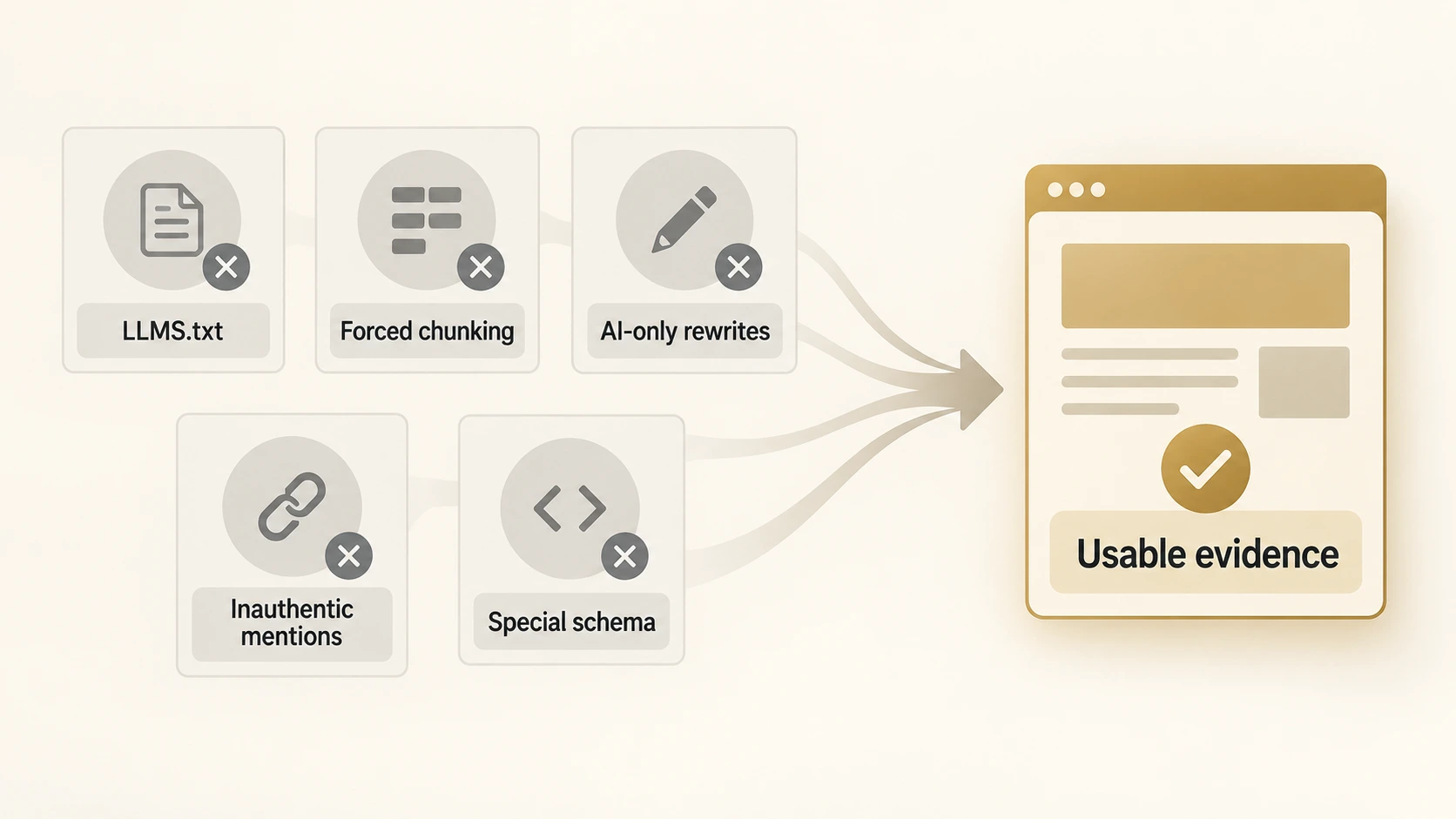
The useful distinction is AI decoration versus usable evidence. Google’s current guidance gives owners a reason to stop confusing the two.
Google’s 2026 guidance is more useful than the AEO label
Google published a new generative AI optimization resource in May 2026 and expanded it in July. Google’s position is plain: generative AI search is still part of SEO because AI Overviews and AI Mode rely on the search index and core ranking and quality systems. Google’s May 15 announcement says the resource includes mythbusting around AEO and GEO misconceptions, and the July 10 guide names them.
This matters because “we are doing AEO” is not a business outcome. What expertise became public? What became easier to crawl? What evidence became easier to verify? What did the team start measuring?
If nobody can answer those questions, you may be buying activity instead of a system.
The five shortcuts Google says not to treat as special AI optimization
In its July 10 guide, Google groups the following under mythbusting for generative AI search.
1. LLMS.txt and other “special” AI markup
Google says it does not use llms.txt or similar AI text files as a special signal for Google Search, and that creating them will neither help nor hurt Google visibility or rankings. Another service may use such a file. Ask one question: which system are we trying to influence, and does that system say it uses this?
2. Breaking every page into tiny content chunks
Google says there is no requirement to split content into tiny pieces for its AI systems. Short sections can help readers, and long technical pages can also be appropriate. Use structure because it improves the page, not because someone told you an answer engine needs artificial chunks.
3. Rewriting normal content into “AI language”
Google says its systems can understand synonyms and general meaning, so you do not need to rewrite every page around every long-tail variation. If your team is manufacturing near-duplicate phrasing while subject-matter experts have never documented customer questions, the priorities are backwards.
4. Manufacturing mentions around the web
Google says its generative features may draw on blogs, videos, forums, and other sites, but warns that seeking inauthentic mentions is not as useful as it may sound. Real third-party authority is independent. Manufacturing the appearance of it misses the point and can drift toward the manipulation Google addresses in its spam policies.
5. Treating structured data like a special AI switch
Google says structured data is not required for generative AI search and there is no special schema.org markup that unlocks it. That does not mean schema is dead. Structured data can still support normal Search features and rich results. Use it for the job it actually does, not as magic AI access.
What does this mean for your company?
The expensive question is probably not technical. It is operational.
Where does your best knowledge live? In sales call notes? A service manager’s explanation? An engineer’s comparison that never reached the product page? The owner’s head?
Google emphasizes valuable, non-commodity content and technical access through Search. For a B2B owner, that points to a practical sequence: capture the knowledge, publish it on an owned page, and make sure the page can be found and indexed.
That is why “more content” is not the answer. Ten pages that answer real buyer questions and document real expertise can be more useful than a hundred generic pages. The Authority Hub Content Engine addresses that operating problem: creating a repeatable path from expertise to an owned authority asset.
Move the budget from shortcuts to an evidence system
Do not cancel useful SEO work because Google criticized AEO hacks. Keep the technical work. Assign it correctly.
| Owner | What that person owns | Definition of done |
|---|---|---|
| Sales or subject-matter expert | Buyer questions, objections, examples, technical distinctions, real-world explanations | The raw expertise is captured in usable notes, audio, transcript, or approved source material |
| Marketing or content lead | Structure, sourcing, editing, internal linking, publishing workflow | The expertise becomes a clear public page that answers a real buyer question |
| Web or SEO owner | Crawlability, indexing, canonical setup, internal discoverability, page experience | The page is technically eligible to be found and served in Search |
| Marketing leader or operator | Measurement and follow-through | The team reviews visibility, traffic, engagement, conversions, and qualified business outcomes separately |
Notice what is missing: nobody owns “do AEO.” Each person owns a real input or handoff. That is a better management system.

Measure the old game and the new game without mixing them together
In June 2026, Google announced dedicated Search Console reporting for AI Overviews and AI Mode. As of August 31, Google says those insights were rolled out worldwide. The Search Console announcement gives owners a separate view of generative AI visibility inside the broader performance picture.
Use that data, but do not turn it into one blended “AI visibility score.” AI impressions, organic clicks, engagement, leads, qualified opportunities, branded searches, and third-party mentions answer different questions.
Did Google surface the page? Did the buyer click? Did attention become an opportunity? Related questions. Different metrics.
What the evidence does not prove
Google’s guidance is about Google Search. It does not prove that every other answer engine ignores llms.txt, uses the same retrieval systems, or values the same controls. It also does not say structured data has no value; it rejects special schema as a generative AI requirement.
Strong content is not guaranteed a citation. Meeting requirements does not guarantee crawling, indexing, or serving. The goal is to stop paying for things the named platform says it does not need and redirect effort into controllable inputs.
And do not use this as an excuse to stop technical SEO. Crawlability, indexability, internal links, page experience, and accessible text still matter.