September 1, 2026 · AEO & Answer Engines · By Bryan Durkin
ChatGPT Changed How It Searches. Your Website Just Became More Important

Suppose your company spent the last six months trying to get mentioned on the websites ChatGPT seemed to cite most. You earned the mentions. You watched a few prompts. Things looked good.
Then the citation mix changed.
That is the problem with building an AI visibility strategy around somebody else’s website. You may benefit from the visibility, but you do not own the source, the platform, or the retrieval system deciding whether that source gets used tomorrow.
Recent ChatGPT search changes make that risk easier to see. Third-party monitoring found a sharp shift in how ChatGPT appeared to run background searches in August 2026, followed by major changes in which outside domains were cited. OpenAI has not publicly confirmed that specific retrieval change or its cause. But OpenAI does confirm something owners can act on: ChatGPT Search uses targeted web queries, and a website needs to be accessible to OAI-SearchBot to be eligible for inclusion.
The distinction is simple: borrowed visibility can move. An owned source can be maintained.
The important ChatGPT search change was not a new ranking factor
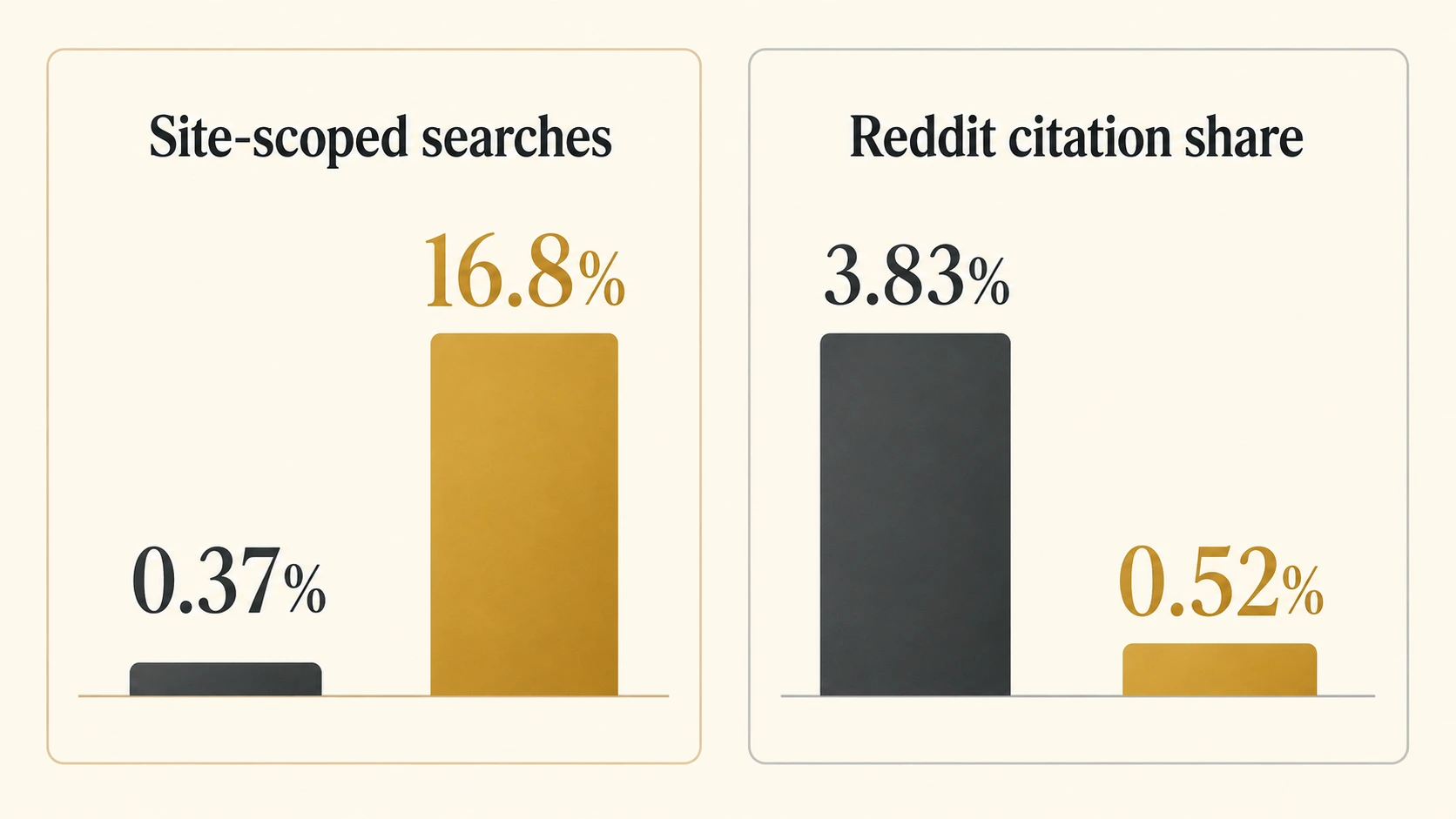
On August 20, Promptwatch published an analysis of a sudden change it had measured inside ChatGPT Search. Its tracking showed that Reddit averaged 3.83% of visible ChatGPT Search citations from July 18 through August 7, then averaged 0.52% from August 14 through August 17. That is an 86.4% relative decline in its dataset. Promptwatch’s August citation analysis also reported that something else changed several days earlier.
On August 8, the tracker observed ChatGPT using domain-scoped site: searches much more frequently. Those queries went from about 0.37% to 16.8% of the background searches it captured. The average number of searches per answer also increased from roughly 1.08 to 1.83.
That is interesting. It is not the same as OpenAI announcing, “Here is our new algorithm.”
Promptwatch can observe what happened in its sample and identify the timing. It cannot prove from the outside why OpenAI’s systems behaved differently. The site-scoped search change is a plausible explanation for some of the citation movement, not a confirmed ranking formula.
That qualification matters because owners do not need another round of people pretending they have reverse-engineered ChatGPT.
Borrowed visibility is useful. It is just not owned.
There is nothing wrong with Reddit, trade publications, industry directories, review platforms, YouTube, LinkedIn, podcasts, or third-party articles. They can provide genuine validation. A buyer may trust an outside source precisely because it is not your company talking about itself.
The mistake is treating one of those channels as infrastructure you control.
Think about the management question. If your AI visibility depends heavily on a forum because ChatGPT happens to cite that forum today, who owns the risk when the retrieval system changes next month? You cannot change the forum’s crawl rules. You cannot control whether an old thread gets indexed. You cannot require ChatGPT to keep treating that domain the same way.
SISTRIX documented the same broader problem earlier in 2026. In its 17-week citation-drift study, ChatGPT source turnover varied materially by country, reaching 74% of domains per week in its German sample. The researchers also found that brand-owned domains tended to be more stable for brand-oriented queries while surrounding co-citations rotated more frequently. The SISTRIX citation-drift study is not proof that every company website will become a stable ChatGPT source. It does show why citation presence should not be treated like permanent shelf space.
You still want third-party authority. You just do not want your entire strategy living on rented ground.
OpenAI gives website owners a much more practical requirement
OpenAI’s own documentation is less dramatic and more useful.
The current ChatGPT Search documentation says ChatGPT may rewrite a user’s question into one or more targeted queries, review initial results, and then run additional, more specific searches. OpenAI also says ranking uses multiple factors intended to surface relevant and reliable information and that there is no way to guarantee top placement.
Then it gives website owners something concrete: if you want your site to be eligible for inclusion, OAI-SearchBot needs to be able to crawl it and your hosting or content-delivery infrastructure needs to allow the crawler.
OpenAI’s publisher guidance goes further. Public websites can appear in ChatGPT Search, and allowing OAI-SearchBot helps content become discoverable, surfaced, cited, and linked. Publishers can also identify referral traffic from ChatGPT through the UTM parameters OpenAI adds to outbound links.
That does not guarantee a citation.
It does tell you what should be on your checklist before somebody sells you a more exotic answer.
Your website has to do more than exist
Being crawlable is the entry requirement. It is not the finished job.
Now ask what ChatGPT would actually find if it reached your site. Would it find a specific answer to the buyer’s question? Or a homepage saying you provide “world-class solutions”? Would it find a current product explanation? Or three conflicting versions of the same fact? Would it find evidence behind the claim? Or another paragraph describing your commitment to excellence?
This is where AI visibility becomes an ownership problem instead of a technical trick.
Your sales team knows which questions buyers ask. Operations knows which facts have changed. Technical people know where the important distinctions are. Customers and outside publications may supply proof. Marketing knows how to turn that information into a public asset. The web team makes sure the asset can actually be reached.
None of those people owns the whole thing alone.
The website becomes useful when those handoffs produce one reliable public source of record. That is the same operating idea behind the Authority Hub Content Engine: start with expertise the company already possesses, structure it, publish it, and keep it accessible.
Build an owned-source workflow instead of chasing citations
Here is a practical way to respond without turning this into another giant marketing project.
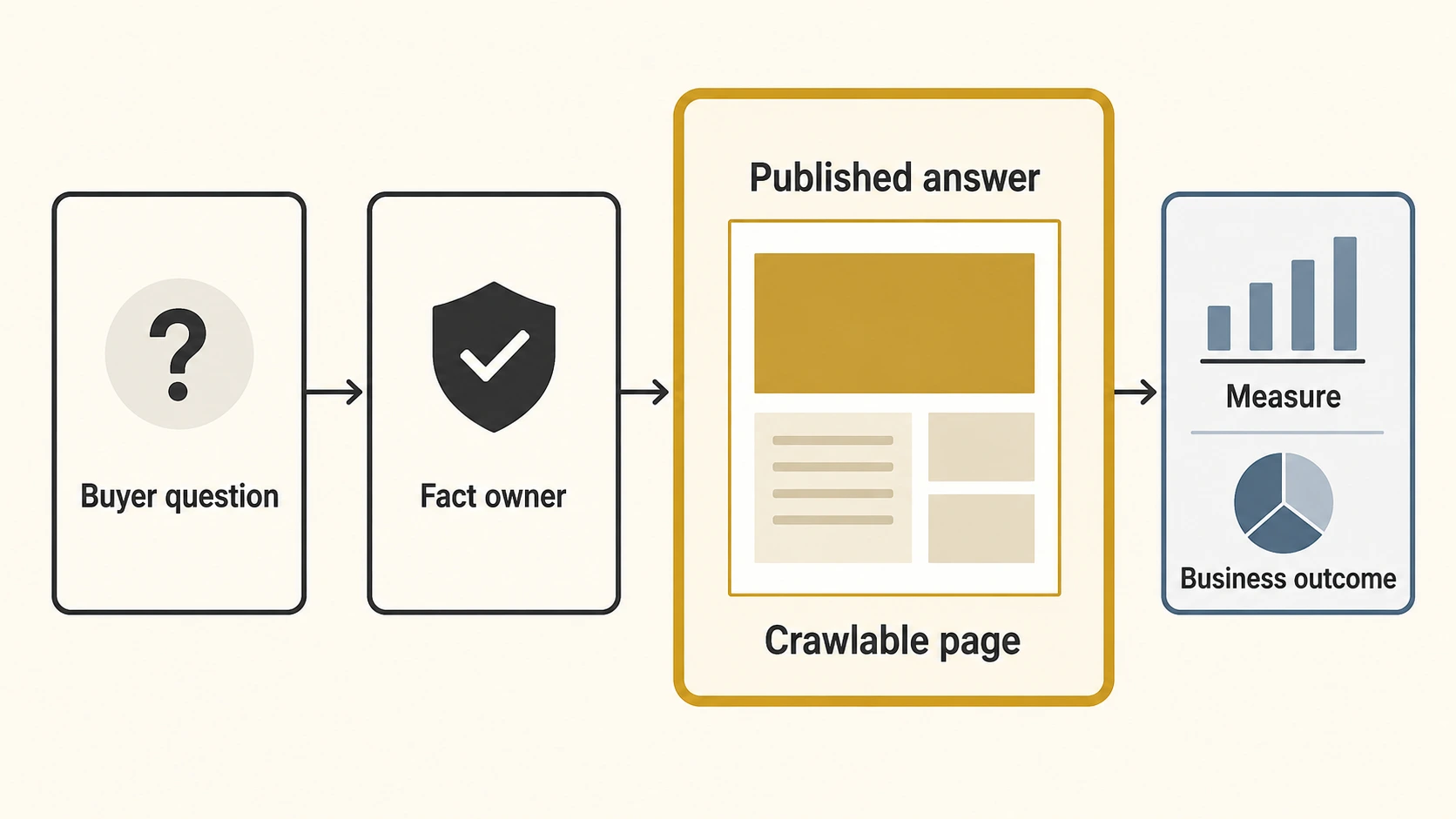
- Choose one buyer question. Start with a question that comes up in sales, service, proposals, or customer conversations and that your company can answer from actual experience.
- Assign the fact owner. Identify who knows the answer well enough to approve it. That may be an engineer, service manager, salesperson, operator, founder, or another subject-matter expert.
- Publish the answer on your domain. Give the question a clear, crawlable page or a meaningful section on an existing page. Do not bury the useful explanation inside a PDF, private portal, social post, or video with no usable text.
- Add proof where it belongs. Specifications, examples, credentials, methodology, customer evidence, external validation, and dates should support claims when they genuinely apply.
- Verify technical access. Your web or SEO owner should confirm the page can be crawled, is not accidentally blocked, has sensible internal links, and does not rely on a script-heavy experience that hides the useful information.
- Measure separately. Track whether the page is indexed, receives search traffic, earns ChatGPT referrals, appears in monitored AI answers, and contributes to qualified opportunities. Those are different signals. Keep them different.
“Done” is not that marketing published another article. Done is that a real buyer question now has an approved, accessible answer on a domain your company controls.
Do not overreact to one citation shift
The Reddit decline does not mean Reddit stopped mattering. Promptwatch itself cautions against making that conclusion. Its data showed a much smaller decline for Reddit citations in Google’s AI surfaces over the same period, which is another reminder that ChatGPT, Google AI Mode, AI Overviews, Perplexity, and other systems should not be blended into one imaginary algorithm.
It also does not prove that ChatGPT now prefers every company’s own website. The August retrieval behavior was observed by third-party trackers, and OpenAI has not publicly confirmed the specific change.
And this is not an argument to abandon PR, reviews, communities, partnerships, or outside publishing. Third-party authority helps a buyer verify what you say about yourself.
The better approach is a two-part system: own the facts and earn the validation.
Measure whether your owned source is becoming usable
You cannot control whether ChatGPT cites a specific page tomorrow. You can control whether the page is available when a system comes looking.
| Signal | What it tells you | Likely owner |
|---|---|---|
| Crawl and index status | Whether search systems can technically access the page | Web / SEO |
| ChatGPT referral traffic | Whether users are clicking through from ChatGPT | Marketing / Analytics |
| AI citation presence | Whether monitored answers are currently using your domain | Marketing / Authority owner |
| Answer accuracy | Whether the company is being represented correctly | Subject-matter owner |
| Qualified opportunities | Whether visibility is contributing to real business conversations | Sales / Leadership |
A citation is not a sale. Traffic is not authority. A mention is not accuracy. Measure each signal for the job it actually performs.